Gold in the Seams: The Case for Brands That Admit What Broke
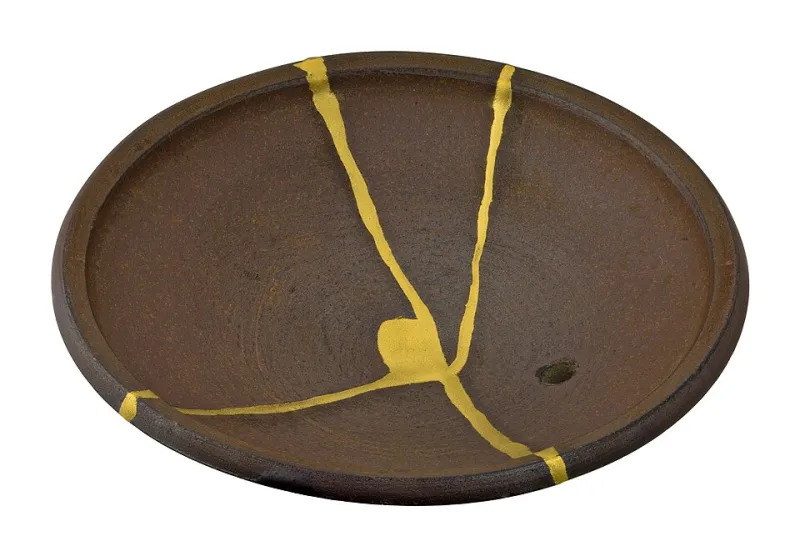
Photo: D-Kuru, CC BY-SA 4.0, via Wikimedia Commons
In our studio, we keep a cracked tea bowl on the shelf. It was repaired years ago with lacquer and gold dust, and the fracture runs through it like a river on a map. Visitors from the United States often ask the same question: is it still broken?
The craftsman's answer is no. It is finished, twice.
The Over-Polished American Brand
There is a particular genre of startup storytelling that has become nearly universal in the American market. A founder sits for a podcast interview and recounts a seamless ascent: the vision arrived fully formed, the product worked, the market responded. Pivots are reframed as "iterations." A painful layoff becomes "a strategic realignment." The rebrand that alienated half the customer base is simply never mentioned.
This instinct is understandable. American business culture rewards momentum, and admitting a wrong turn can feel like handing ammunition to competitors and investors alike. But something quieter is lost in the polishing. When every brand story is frictionless, none of them are believable. Audiences have developed a fine-tuned detector for the too-smooth narrative, and increasingly they read perfection as concealment.
Trust, it turns out, is not built on the absence of failure. It is built on evidence of repair.
What Kintsugi Actually Teaches
Kintsugi is often reduced in Western writing to a tidy metaphor: broken things become beautiful. But the practice carries a stricter lesson. The repair in kintsugi is not disguised. Gold is used precisely because it announces the mending. The bowl does not pretend the break never happened; it declares, with some dignity, that it survived.
The philosophical commitment underneath is to honesty about an object's history. A repaired bowl is considered more valuable, not less, because its story is legible in the object itself.
Now hold that against the modern brand playbook. A company scrubs its website of every trace of a discontinued product line. A founder deletes the 2019 blog post that contradicts the 2024 strategy. The brand, in effect, claims to have arrived at its current shape without a history — which no one believes, and which quietly signals that the company is uncomfortable with its own past.
Scars as Signature: Two American Examples
The encouraging news is that some of the most trusted American brands have already absorbed this logic.
Basecamp has spent two decades writing publicly about its own missteps — pricing reversals, product sunsets, internal disagreements aired in long, unflinching blog posts. When the company went through its painful 2021 restructuring, co-founders Jason Fried and DHH published accounts that were candid to the point of discomfort. The result is a brand whose customers extend it remarkable goodwill, because Basecamp has demonstrated, repeatedly, that it will tell them the truth even when the truth is unflattering.
Liquid Death built a billion-dollar water brand partly on the admission that its product is absurd. The company never pretends canned water is a noble necessity; it sells the joke openly, and that self-awareness functions as a form of honesty. Consumers reward it because the brand is not performing a seriousness it does not feel.
In both cases, what looks like vulnerability is actually the most defensible brand asset on the balance sheet: a demonstrated habit of telling the truth.
A Framework for Repair-Forward Storytelling
For founders and brand leaders ready to let the gold show, we suggest four practices.
1. Audit for the deleted chapter. Every company has one — the product that failed, the co-founder who left, the pivot that nearly ended things. Ask: what are we pretending did not happen? You need not publish everything. You do need to stop structuring your narrative around concealment.
2. Name the repair in your own voice. When you reverse a decision, say so plainly: "We got this wrong, and here is what changed our thinking." A short, specific post outperforms a vague changelog entry. Specificity is what separates acknowledgment from spin.
3. Let the seam stay visible in the product. Legacy features, old logos in the archive, the version number that skips a digit — small traces of history signal longevity and continuity. Companies that scrub every artifact of their past read as temporary, however large they become.
4. Reserve the polish for the promise, not the past. There is nothing wrong with aspirational messaging about where you are going. It is the rewritten history that corrodes trust. Point the gold forward.
The Long Return
There is a final point worth making to a market that optimizes quarterly. A repaired bowl cannot be rushed. The lacquer cures for months. Kintsugi's deeper instruction is patience: trust compounds slowly, and it is assembled from moments when a company chose candor over convenience.
American founders do not need to adopt Japanese aesthetics to benefit from this. They need only accept that their customers are not looking for a flawless story. They are looking for a true one — seams, gold, and all.
The bowl on our shelf holds tea every morning. It has never been stronger than where it broke.