Show the Crack: What a Teacup Taught Me About Winning Over Investors
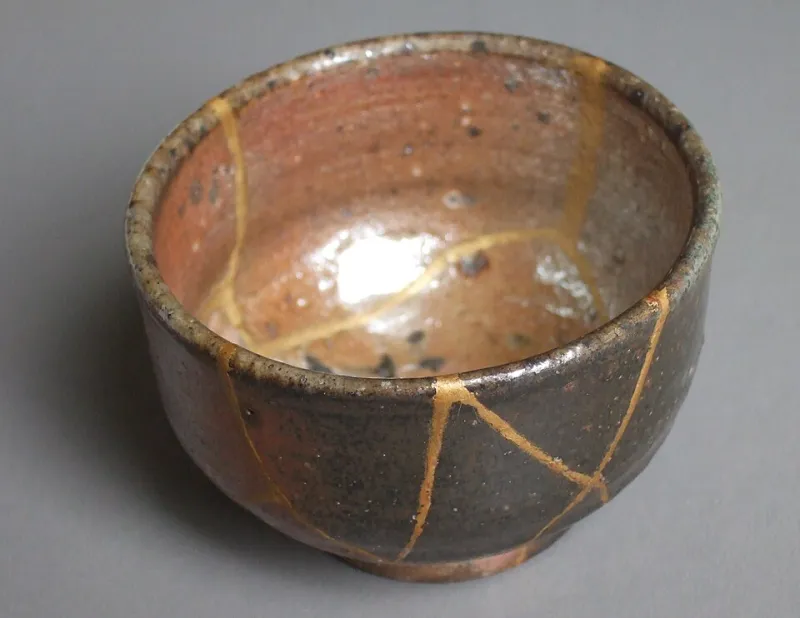
Photo: Haragayato, CC BY-SA 4.0, via Wikimedia Commons
In the Nishijin district of Kyoto, where weavers have produced silk for over a thousand years, there is a quiet understanding among master craftsmen: a piece that appears too perfect invites suspicion. The eye searches for the flaw it assumes must be hidden. American startup culture has built an entire ritual around avoiding this suspicion — and, in doing so, has made itself less trustworthy.
The Tyranny of the Polished Deck
Pitch season in San Francisco or New York follows a familiar choreography. Founders memorize forty slides. Advisors drill them on objection handling. Every metric is rounded up, every risk buried in an appendix nobody opens. The result is a performance so seamless it feels weightless — and weightless is precisely the problem.
Investors see hundreds of decks a year. They have developed a kind of sensory fatigue toward polish. A flawless presentation signals one of two things: either the founder doesn't know what they don't know, or they've decided the audience cannot handle the truth. Neither interpretation builds confidence.
Wabi-Sabi as a Presentation Discipline
The Japanese aesthetic of wabi-sabi finds beauty in the imperfect, the incomplete, the weathered. Applied to a pitch, it is not an excuse for sloppiness. It is a deliberate act of curation — choosing which imperfections to reveal, and framing them as evidence of judgment.
Consider the difference between these two statements:
"Customer acquisition is highly efficient across all channels."
versus
"Paid acquisition works beautifully in coastal markets, but our Midwest pilot taught us our messaging falls flat outside major metros. We've hired someone from that region to lead positioning — here's what changed."
The second statement contains a crack. It also contains a response, a lesson, and a person. It demonstrates that the founder observes reality rather than narrating a highlight reel. In Kyoto's craft tradition, the visible repair — the gold seam of kintsugi — is not a confession of failure. It is proof that the object was worth repairing and that its owner understood its structure well enough to mend it.
A Practical Framework: The Three-Seam Pitch
We suggest founders deliberately build three admissions into their narrative:
-
The market seam. Name the segment or geography where your product underperforms, and explain what you learned from it. This transforms a weakness into proof of intellectual honesty.
-
The personal seam. One sentence about a decision you got wrong and how it changed your operating approach. Investors are not funding spreadsheets; they are funding people who can metabolize error.
-
The model seam. The assumption you are least certain about, stated plainly, followed by your plan to test it. A founder who identifies their own fragile assumption has done the investor's diligence work in advance.
The discipline lies in restraint. Three seams, not thirty. Each must be genuine, specific, and paired with a response. An unexamined confession is not wabi-sabi; it is negligence.
Why This Works on American Audiences
There is a cultural mismatch worth naming. US business culture prizes confidence, and founders fear that vulnerability reads as weakness. But the American investor's deepest anxiety is not that a founder will fail — it is that a founder will hide failure until it is catastrophic. A pitch that demonstrates early, voluntary disclosure lowers the perceived risk of everything else in the room.
The most persuasive founders we have observed share a quality: they speak about their companies the way a master woodworker speaks about a beam with a knot. Here is the grain. Here is where it wants to split. Here is how I work with it. That is not a lack of ambition. It is the posture of someone who intends to still be building in twenty years.
The Quiet Close
A pitch is, ultimately, an act of design. It composes information to produce a feeling — and the feeling that closes deals is not admiration of perfection. It is trust. Leave room in your deck for the crack to show. Gold it carefully, and let it catch the light.